Ask around Belmont and you'll hear the number before you hear the map: 1,632. That's the count of multi-family units the town had to zone for under the state's MBTA Communities Act, and it's become shorthand for a coming wave of new housing. Buyers weighing Belmont against Watertown or Arlington bring it up unprompted. Sellers near Waverley Square wonder if it changes what their two-family is worth. Investors ask whether their duplex just became a teardown opportunity.
The number is real. The story built around it isn't quite right, and the gap between the two is the part worth understanding before you write an offer or list a property here.
What "Zoned For" Actually Means
Section 3A of the state's zoning act required Belmont, as a commuter rail community, to designate at least 28 acres of land where multi-family housing is allowed by right, at a minimum density of 15 units per acre, producing legal capacity for 1,632 additional homes, 15 percent of the town's roughly 10,882-unit housing stock. Town Meeting approved a compliant map by a vote of 213 to 8 in the fall of 2024, and the state's Executive Office of Housing and Livable Communities signed off in the spring of 2025.
When Belmont Select Board Chair Roy Epstein wrote to local reporters during the debate, he put the distinction plainly: the town needed to zone for the units, not build them. That line has aged well. Belmont is still actively adjusting the technical language of its own zoning bylaw well over a year after the state's approval. Amendments passed at a March 2026 Special Town Meeting and again at the May 2026 Annual Town Meeting were still sitting with the Attorney General's office for review as of this writing, according to the town's own zoning bylaws page. Compliance wasn't a single event in 2025. It's an ongoing process the town is still refining in 2026.
That matters for how you read the 1,632 figure. It's a ceiling on what's legally possible, set by formula, not a forecast of what will get built or when.
Two Maps, One Vote, and Why the Map That Lost Explains More Than the One That Won
Before Town Meeting settled on a final plan, Belmont's planning process weighed two competing versions of the map. One upzoned "Lower Belmont," the built-up southeast corner of town where multi-family buildings already sit on many lots. The other would have swapped in a very different kind of parcel: the Purecoat site on Brighton Street, an industrial property currently occupied by a metal-plating operation, sitting largely vacant of housing today.
Local housing advocates argued the Purecoat swap would generate more real new construction, precisely because it wasn't already built out. Town Meeting rejected that amendment. The map that passed leaves the industrial parcel as is and instead applies new multi-family capacity to areas including Waverley Square, the Belmont Housing Authority's Thomas Street property, sections of Concord Avenue near the library and near Bright Road, and the Pleasant Street area near Brighton Street.
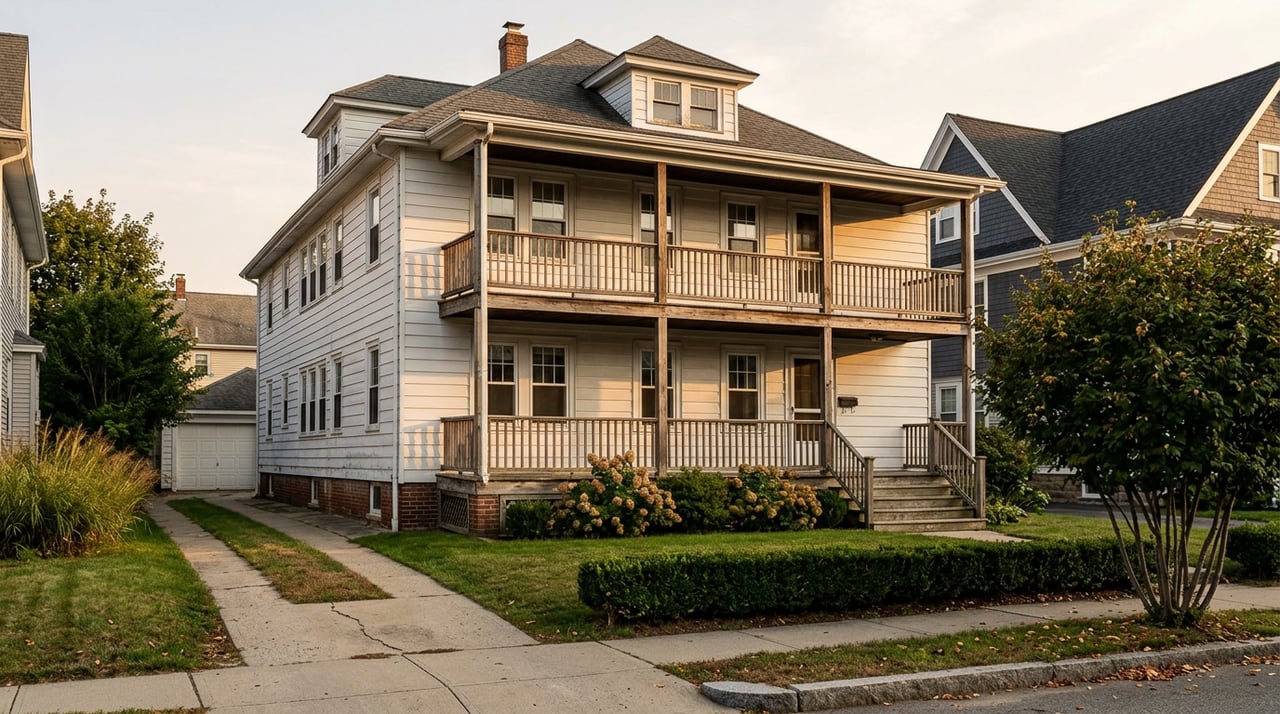
Here's the mechanism that number-watchers tend to miss: a meaningful share of the newly rezoned lots in the built-up districts already contain a triple-decker or a two-family home. Belmont's own planning department has acknowledged that tearing down an existing three-family to build another three-family in its place makes no financial sense, and replacing a working two-family with a three-family often doesn't pencil out either. The zoning creates the legal right to build denser. It doesn't create a financial reason to knock down a building that's already producing rental income at a similar density.
The subdistricts vary in what they'd theoretically allow:
| Subdistrict | Typical building types | Approximate density |
|---|---|---|
| Subdistrict 1 | Triple-deckers, six-plexes, eight-plexes | ~15.5 units/acre |
| Subdistrict 2 | Townhouses, apartment blocks | ~28.8 units/acre |
| Subdistrict 2A | 4-5 story apartment blocks (Belmont Housing Authority parcels only) | ~23.5 units/acre |
| Subdistrict 4 | Mandatory mixed-use with ground-floor retail | ~27 units/acre |
Subdistrict 2A is the outlier worth noticing, because it isn't subject to the private redevelopment math that stalls the rest of the map.
The One Project Already Moving
Sherman Gardens, an 80-unit senior housing complex built in 1971 by the Belmont Housing Authority in the Waverley neighborhood near Sycamore and Brown Street, is slated for redevelopment into a 125-unit mid-rise building with elevators, a net gain of 55 deeply affordable units. It's part of the town's broader Housing Production Plan target of adding roughly 293 affordable units over five years to reach 10 percent of Belmont's year-round housing stock. The earliest construction could start is 2026, though the Housing Authority itself notes that date isn't locked in and may slip.
Sherman Gardens sits on Belmont Housing Authority land, which is exactly why it's further along than anything in the private market. Public land isn't waiting on a private owner to decide whether the numbers work. It's the closest thing Belmont has to a guaranteed construction project tied to the 3A rezoning, and it's public affordable housing, not the kind of market-rate multi-family the 1,632 figure conjures in most people's minds.
What This Means If You're Actually Looking at a House Here
If you're a family comparing a single-family listing in Belmont against one in a neighboring town, the rezoning is close to irrelevant to your decision. The named districts sit in specific pockets, mostly around Waverley Square and the Housing Authority parcel off Thomas Street. A single-family home outside those boundaries isn't newly eligible for multi-family conversion, and the character of most residential streets in town is unaffected by the map that passed.
If you're an investor evaluating a two- or three-family inside one of the rezoned subdistricts, the upzoning gives you a legal option you didn't have before, but the town's own analysis suggests most existing multi-family lots won't be worth redeveloping. The more interesting opportunity, if one exists, sits with underbuilt parcels inside those districts, a single-family lot or an aging duplex on a site now zoned for denser construction, where the density gain is large enough relative to what's already there to make the numbers work. That's a property-by-property question, not a neighborhood-wide one.
If you're selling a property near Waverley Square, being inside a rezoned district doesn't automatically translate into buyer interest tied to redevelopment potential. Being zoned for something and being an attractive site for a builder to actually pursue are two different questions, and conflating them in a listing narrative can set the wrong price expectation.
Prices Haven't Moved Yet, and That's Consistent With the Mechanism
Belmont's sale prices over the three months ending in June 2026 came in around a $1.4 million median, down 7.2 percent from the same period the year before, with homes averaging 17 days on market compared to 13 days the prior year and 55 homes sold in June versus 62 a year earlier. Other sources tell a slightly different story depending on methodology and time window: one home-value index put the typical Belmont home closer to $1.35 million as of mid-2026, while active listing prices in August 2026 skewed higher, near $1.64 million. The spread across sources is itself a useful reminder that a single median figure depends heavily on which homes sold, when, and how a given site defines the window.
What none of these figures show is a market bracing for a flood of new multi-family supply. That's consistent with the mechanism above. Zoning capacity doesn't move prices. Completed construction does, and Belmont doesn't have much of that yet outside a public housing project still working through funding and design. The softening that shows up in the 2026 numbers tracks the broader rate environment more than it tracks the rezoning.
A Few Questions Worth Answering Directly
Does the new zoning force my single-family home to allow multi-family units? No. The 3A districts are specific, mapped parcels, mostly concentrated around Waverley Square and a handful of named corridors. A property outside those boundaries keeps its existing zoning.
My duplex sits inside a rezoned district. Do I have to add units? No. The zoning creates a right for a property owner to build denser if they choose to and can make the finances work. It doesn't create an obligation.
Will this eventually lower Belmont's home values? Nobody can say that with confidence yet, and anyone who tells you otherwise is guessing. The zoning sets a ceiling on legal capacity. Actual construction, and any price effect that might follow it, depends on financing, site-specific economics, and a permitting process that's still unfolding nearly two years after the map first passed Town Meeting.
If you're weighing a purchase near one of these districts, or you own a two- or three-family and want an honest read on whether the new zoning actually changes your redevelopment math, that's a property-specific conversation, not a headline-number one. Vahan Sardaryan works this market street by street. Schedule a free consultation and we'll go through your specific address against the actual map, not the number everyone's repeating.